Understanding Dementia & Driving
The Hartford Center for Mature Market Excellence® partnered with the MIT AgeLab to conduct research to bring clarity to the very serious and emotional issue of dementia and driving and to help drivers and their families plan a successful transition from driver to passenger.
More than 5 million people in the U.S. are afflicted with dementia, with Alzheimer's disease being the most common form. Deciding when to limit or stop driving can be a confusing issue for individuals diagnosed with dementia and their caregivers. Earlier diagnosis and better medications may allow people to drive longer, further complicating the decision on dementia and driving. However, as the disease progresses driving skills will diminish, and the person with dementia must stop driving. Most information about dementia warns against driving, but does not describe when or how to stop.
Alzheimer’s: Not Like Common Changes in Later Life
Alzheimer’s Disease is not like other changes in later life that affect driving, such as eyesight problems and slow reaction times. Many older adults who don't have dementia can assess their driving without family intervention and make gradual changes to the way they drive. And most are able to continue driving safely throughout their lives.
Changes in Persons With Dementia
It's different for those with Alzheimer's Disease and other dementias. The progression of this disease is usually gradual and somewhat unpredictable. It affects cognitive functions critical to driving. Everyone with Alzheimer's Disease or other irreversible causes of dementia will eventually lose the ability to drive safely, due to problems with:
- Judgment
- Multi-tasking
- Slowed reaction times
- Impaired spatial skills
- Other cognitive deficits
With dementia, an individual's capacity to assess his or her driving abilities may also diminish. People with dementia are especially likely to minimize the complexity of driving and overestimate their abilities.
As driving and assessment skills decline, the risk of serious loss or injury increases. Caregivers must step in and assume the responsibility for monitoring and regulating the driving of the person with dementia.
The Impact of Family Relationships
No two families dealing with dementia resolve transportation issues in exactly the same way. Roles and relationships within families can affect decisions about when and how a person should stop driving.
Individual responses of family members may vary. For example, a caregiving spouse may try to protect the person with dementia by withholding information about driving incidents from adult children. An adult child may intervene on matters of safety, even though this might affect the relationship with the parent. One person may avoid confronting the driving concerns of the family member, while another may take charge of the situation and act without input from others.
Caregivers need to remember that family members follow long-established patterns for making decisions. It is unrealistic to think that patterns will change when handling a difficult issue like driving safety. Caregivers can work to minimize friction by listening to different opinions and appreciating what each person can contribute, even if it differs from their point of view.
Disagreements in families are often the result when individuals do not have the same opportunities to assess driving abilities. Having factual information about driving behavior does not guarantee families will reach consensus on when to limit driving. However, frequent, open communication about specific, observed behaviors and concerns may help to lessen differences. Everyone involved in caring for the person with dementia can help by focusing on the key issues - the self-respect of the person with dementia and the safety of everyone on the road.
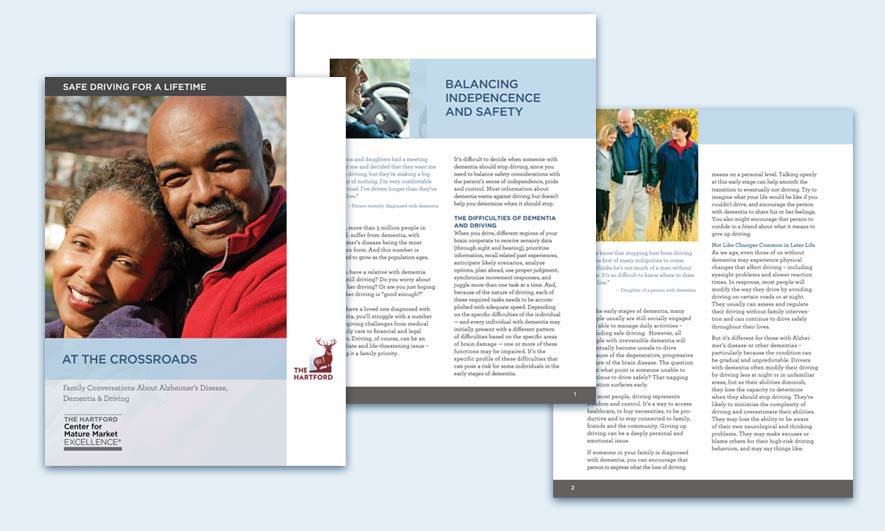
When it’s time for loved ones with dementia to stop driving and how to help them cope with driving cessation. download or order your free copy of At the Crossroads (Family Conversations about Alzheimer’s Disease, Dementia & Driving).