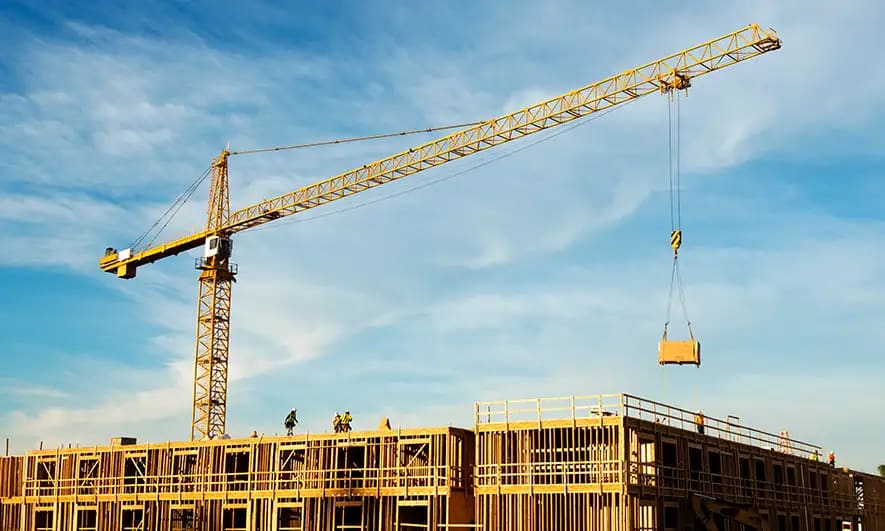

From bridges and tunnels to high-rise homes in coastal areas, more construction projects are falling into a high-risk profile. As economic, political and environmental indicators push these projects beyond traditional insurance options, wholesale casualty coverage offers the right security to get contracts approved and shovels in the ground.
High-Risk Construction Gets More Complex
Casualty insurers must underwrite increasingly volatile risks, often in high-hazard sectors like skyscraper construction, coastal development and infrastructure megaprojects. This high-stakes, high-complexity environment is expected to grow as regulations increase and volatility in the construction space continues.
Economic Uncertainty
The past five years have kept the construction industry on its toes and reshaped risk profiles, with governmental and economic changes putting current and future construction projects on shaky ground.
U.S.-imposed tariffs on materials like steel and aluminum are now at 50%, and additional tariffs are in flux, making it difficult to meet budgets and scope future projects.1 Planning alone can take years before even breaking ground, and once a job starts, any shift in material or labor costs can increase premiums and undermine budget forecasts.
Additionally, contractors and insurers are shifting strategies to counter economic impacts from rising interest rates (nearing 10%) and limitations on borrowing.2
“With all of the uncertainty surrounding the future cost of goods and labor, many developers are hesitant to start jobs or take on a significant pipeline of work,” explains Kyle Sternadori, head of casualty for Navigators, a brand of The Hartford. “Having to account for higher costs midway during the course of construction can result in funding problems as well as quality issues.”
Environmental Impacts
In recent years, identification of construction deficiencies in coastal areas has led to heightened risk assessments. The concern is not only the structures under construction but surrounding structures as well – especially those built more than 20 to 30 years ago.
"Especially in places like Florida, there is significant demand for high-rise residential buildings in areas with challenging soil conditions,” says Sternadori. “Effective underwriting requires much more scrutiny of adherence to building codes and best practices. Value-added risk engineering services can help developers ensure they are utilizing means, methods and materials that reduce their risk."
Weather-related disasters, like hurricane season on the eastern seaboard and wildfires in the west, compound the state of complex construction. Global economic losses from natural disasters were estimated at $368 billion in 2024.3
Litigation Trends
Construction sites are inherently risky and subject to lawsuits, a challenge in an increasingly litigious society. Monetary awards are also climbing. For instance, a jury awarded $860 million to a woman’s estate after a nearby construction crane crashed into her apartment and killed her.4 Even smaller awards can add up, increasing risk and putting pressure on the cost of insurance policies.
“Everything is just so much more litigation focused,” says Sternadori. “You have legal system abuse, including aggressive attorney advertising and so many other issues that are driving costs through the roof. For example, litigation financing has become a multibillion-dollar business.”
As exceptionally high jury awards, known as nuclear verdicts, become more frequent and severe, loss costs are also rising, growing at a pace exceeding inflation. The increase in loss costs has resulted in a more challenging market for acquiring funding and insurance as carriers contemplate potentially large losses.
“The cost of everything, including materials and labor, is much higher today than it was three or five years ago. So, the cost to fix or replace defects in construction has increased as a result,” Sternadori explains.
Wholesale Excess Casualty Meets Demands
Wholesale insurance is a much-needed solution for the complexity of modern-day construction risks. Without adequate limits, contractors can’t even step onto a job site. The ability to acquire coverage, especially in challenging venues like Florida or New York, can make or break a project.
Managing Volatility With Specialization
Insurers who specialize in excess and surplus lines (E&S) typically employ staff with decades of insurance experience and deep expertise in a designated field. Guided by internal data, actuarial insights and claims collaboration, underwriters can stay ahead of loss trends and refine appetite in the high-risk construction space.
Staying Agile in Coverage Creation
The flexibility of non-admitted coverage to craft tailored solutions for wrap-ups, project-specific placements and distressed accounts is one of the greatest strengths of the E&S market. Underwriters have the freedom to refine pricing models and coverage terms and examine historical claims data and emerging trends to offer policies that meet coverage needs while safeguarding against rising claims.
Utilizing Best Practices To Manage Risk
Claims severity is rising, especially in bodily injury claims. There are many contributing factors to this, including social and economic inflation and legal system abuse. Treating injuries has become more expensive, and even minor injury settlements are finding their way into excess layers. This can be troubling in jurisdictions that apply strict liability, where contractors may be held responsible for injuries regardless of fault, under local labor laws.
According to Sternadori, underwriting for job site injuries depends greatly on contractor best practices and job site safety. Contractors who employ active safety teams on a job site are better able to mitigate risks.
Broker Collaboration
With carriers pulling back on capacity, especially on tougher risks, brokers who bring well-structured submissions early in the process are more likely to secure the coverage their clients need in today’s constrained market.
“When brokers understand the risk and communicate early, it builds confidence,” Sternadori explains. “That’s how we unlock capacity in a constrained environment. They’re in it just as much as we are, and their early engagement helps us get comfortable quoting tough risks.”
The Navigators Advantage
Experienced carriers leverage historical knowledge, identify future trends and focus on what high-risk projects need to satisfy insurance coverage demands.
“At Navigators, construction represents a significant portion of our casualty book,” says Sternadori. “We have more than two decades of experience writing construction and understand the long-tail losses and complications that can come ten years after a build. It’s very difficult to operate profitably in this market without the perspective we have.”
With more than $600 million in construction premiums in 2024, Navigators is a market leader.6 “When we sign on to a risk, it can be a signal to other carriers who can write layers on top of our layer, allowing brokers to create towers of coverage,” he says.
Learn more about casualty coverage from Navigators, a brand of The Hartford’s wholesale team.
1 The Hartford’s Global Insights Center: Monthly Newsletter.
2 Associated General Contractors of America | Will U.S. Construction Thrive or Dive in the Rest of '25?, viewed July 2025.
3 The Financial Impact of Extreme Weather: Essential Information for Business Leaders |The Hartford, viewed July 2025.
4 Jury Awards $860 Million After Daughter Killed in 2019 Dallas Crane Collapse – NBC 5 Dallas-Fort Worth, viewed July 2025.
6 The Hartford’s internal data.
General Product Description | This general product description is information only and designed for insurance producers. It is neither an offer to sell nor a solicitation to purchase any particular insurance product, and may not be disseminated to the general public. This general product description outlines the coverage(s) that may be afforded under a policy from The Hartford. All policies should be examined carefully for suitability and to identify all exclusions, limitations and other terms and conditions. In the event of a conflict between any policy and this document, the terms and conditions of the policy shall control.
About Surplus Lines Coverage | The coverage(s) identified in this general product description may be written on a surplus lines basis. Eligibility for surplus lines insurance coverage is subject to state regulations and requires the use of a surplus lines broker. Surplus lines insurance policies are generally not protected by state guaranty funds. In connection with the insurance offered herein, the broker is responsible for any disclosure or stamping requirements associated with surplus lines policies, and compliance with any declination, due diligence, or record-keeping requirements for surplus lines policies, and collection and payment of the applicable surplus lines premium taxes and any other applicable surcharges owed on each policy and to make any related filings. Surplus lines coverage is underwritten by Navigators Specialty Insurance Company, Maxum Indemnity Company, Pacific Insurance Company Ltd. (except in CT and HI) and Hartford of Illinois Insurance Company in CT and HI.
About The Hartford Underwriting Companies | The coverage(s) identified in this general product description may be underwritten by one or more of the property and casualty insurance companies of The Hartford Insurance Group, Inc. In Texas, Arizona, New Hampshire, Washington and California, this insurance is underwritten by Hartford Accident and Indemnity Company, Hartford Casualty Insurance Company, Hartford Fire Insurance Company, Hartford Insurance Company of the Midwest, Hartford Insurance Company of Illinois (CT and HI only), Hartford Lloyd’s Insurance Company (TX only), Hartford Underwriters Insurance Company, Maxum Casualty Insurance Company, Maxum Indemnity Company (not licensed in CA), Navigators Insurance Company, Navigators Specialty Insurance Company (not licensed in CA), Pacific Insurance Company Ltd. (except in CT and HI) (not licensed in CA), Property and Casualty Insurance Company of Hartford, Sentinel Insurance Company, Ltd., Trumbull Insurance Company and Twin City Fire Insurance Company and its property and casualty insurance company affiliates, One Hartford Plaza, Hartford, CT 06155.
The Hartford Insurance Group, Inc., (NYSE: HIG) operates through its subsidiaries, including underwriting company Hartford Fire Insurance Company, under the brand name, The Hartford®, and is headquartered at One Hartford Plaza, Hartford, CT 06155. For additional details, please read The Hartford’s legal notice at https://www.thehartford.com.