


When it comes to maritime operations, public entities like police boats, fire department fleets and university research vessels are tasked with a specific mission: to serve the community.
This responsibility, along with protecting community assets and ensuring safety above all else, separates public entities from traditional commercial operations. Yet many are still insured under marine programs originally designed for commercial operators who do have the option to delay operations or avoid risk. This misunderstanding can:
- Lead to unexpected gaps at critical moments.
- Lock municipalities into premiums that don’t reflect their real exposures.
- Undermine confidence in the risk management process for leadership and taxpayers alike.
“What’s important to remember is that public marine operations are not optional,” says Peter DiLalla, executive underwriter at The Hartford. “When emergencies arise - whether it’s a rescue, a fire response or a public safety incident – municipal vessels deploy regardless of weather, cost or convenience.”
Now more than ever, municipalities should take a closer look at their marine insurance coverage to ensure they have the right protection for their very specific needs.
The Difference Between Public and Private Marine Operations
Nearly 40% of the United States population now lives in coastal counties, and the rate of growth continues.1 With that comes the need for more water-based services like:
- Law enforcement patrol units that conduct emergency responses, perform crowd control on waterways and deploy other special operations.
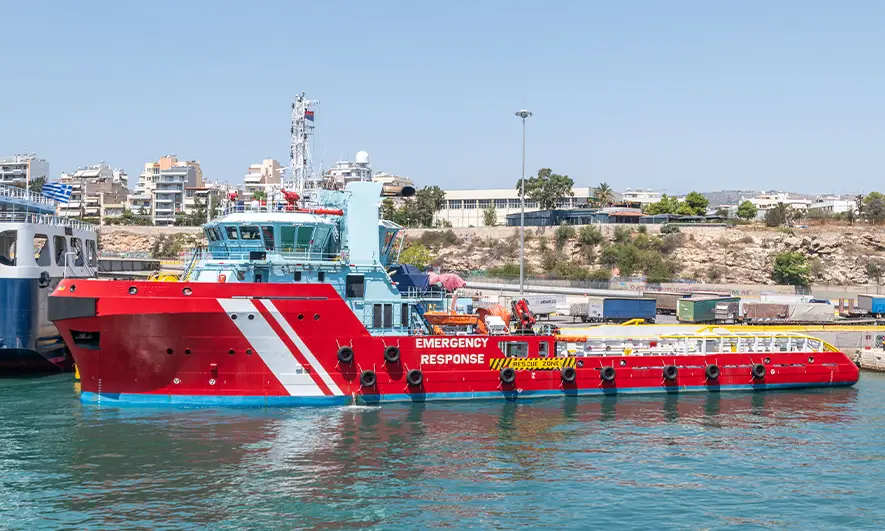
- Fire departments boats for firefighting, rescue and hazardous material response.
- University vessels for marine research, student training and environmental study.
Unlike standard commercial operators, public entities don’t run vessels to generate revenue, and their exposures are different than those in the private sector. Their crews are often a mix of sworn officers, municipal employees, volunteers or even students. And their accountability isn’t to shareholders or owners - it’s to taxpayers, communities and the public good.
“Because they are public entities, they’re held to a lot of governmental regulation, public scrutiny and legal implications that a commercial operator doesn’t have,” says Courtney Schaller, director of underwriting at The Hartford.
And while commercial operators have some flexibility in mitigating risk – like tapping into funding resources or postponing shipping out because of weather - public entities do not.
“If a fire boat needs to deploy in the middle of the night in a storm, they answer the call,” Schaller explains.
The Complexity of Ocean Marine Claims
While exposure continues to grow, public-sector budgets remain constrained. These maritime services are funded by tax dollars and grants, with strict limitations on how funds can be used. And while public entity marine losses may occur less frequently than their private counterparts, they tend to be higher in severity due to the specialized nature of the vessels, mission-critical use and the operational consequences of downtime.
In addition, the cost to repair or replace specialized vessels continues to rise. A single fireboat or patrol vessel can represent a multimillion-dollar investment, so having the wrong coverage can be costly when losses occur. They’re also subject to regulatory constraints that can make filing a claim quite complicated.
“The process can be slow, fragmented and misaligned with public-service realities,” says DiLalla. “Coverage that doesn’t reflect public-sector operations inevitably reveals its weaknesses at claim time, often through delays caused by policies that were never designed with public accountability in mind.”
How To Review Ocean Marine Coverage
Typically, municipality or public-sector clients are offered marine coverage written for a commercial fleet and “adapted” with riders or carve-outs. The exclusions don’t line up with their real risks, and they’re paying for coverage they’ll never use because they’re not hauling cargo or running cruise excursions.
“For too long, those organizations have been forced into buying insurance products that simply weren’t built for them, and it’s costing brokers, public entities and taxpayers more than we realize,” says DiLalla.
He encourages municipalities and other public organizations to closely review their current insurance policies for coverage gaps that could leave them exposed. Questions to consider include:
- Does the policy include tailored coverage language for patrol launches, fireboats and research vessels?
- Can the underwriter handle multiple lines of coverage, so brokers and clients aren’t bounced around due to silos?
- Do endorsements reflect public service operations, not commercial contracts?
- Are limits arbitrarily capped or do they scale with the size of the mission?
- Will the claims team understand and adapt to the urgency, regulatory needs and accountability of public service?
It’s critical for public entities to partner with an insurance carrier that can offer tailored coverage solutions created specifically for the maritime industry.
“Public entities don’t need commercial marine policies with a few endorsements added on. They need coverage designed from the ground up to support public-service missions,” DiLalla says.
Learn how our specialized ocean marine coverage can support your risk management program.
1 NOAA’s Office for Coastal Management, “Economics and Demographics,” viewed January 2026.
The information provided in these materials is intended to be general and advisory in nature. It shall not be considered legal advice. The Hartford does not warrant that the implementation of any view or recommendation contained herein will: (i) result in the elimination of any unsafe conditions at your business locations or with respect to your business operations; or (ii) be an appropriate legal or business practice. The Hartford assumes no responsibility for the control or correction of hazards or legal compliance with respect to your business practices, and the views and recommendations contained herein shall not constitute our undertaking, on your behalf or for the benefit of others, to determine or warrant that your business premises, locations or operations are safe or healthful, or are in compliance with any law, rule or regulation. Readers seeking to resolve specific safety, legal or business issues or concerns related to the information provided in these materials should consult their safety consultant, attorney or business advisors. All information and representations contained herein are as of January 2026.
Links from this site to an external site, unaffiliated with The Hartford, may be provided for users' convenience only. The Hartford does not control or review these sites nor does the provision of any link imply an endorsement or association of such non-Hartford sites. The Hartford is not responsible for and makes no representation or warranty regarding the contents, completeness or accuracy or security of any materials on such sites. If you decide to access such non-Hartford sites, you do so at your own risk.
The Hartford Insurance Group, Inc., (NYSE: HIG) operates through its subsidiaries, including the underwriting company Hartford Fire insurance Company, under the brand name, The Hartford,® and is headquartered in Hartford, CT. For additional details, please read The Hartford’s legal notice at https://www.thehartford.com