


Among the many things school staff in America worry about in a day, school violence continues to be a top concern. A 2025 survey found that 22% of principals feared being victims of harm at school and 40% worried about student safety. Among teachers, 21% feared for their own safety, while 45% feared for students.1
These concerns are not without merit. In fact, 28% of principals surveyed report direct threats of violence from students or the community.2 And although violent incidents in schools have decreased slightly overall, from 699 in 2022 to 490 in 2025, there were 17 school shootings in 2025 and a recorded 238 such shootings since 2018.3,4
As school resource officers and lockdown drills become more common in schools across the U.S., school safety is as regular a part of the school day as book reports and morning announcements.
How Can Schools Prevent Violence?
Creating a safe school environment requires a holistic approach, combining student-centered learning with support services that address physical, mental and behavioral challenges. Factor in the support of the community, and schools have a better chance of gaining more student support services, smaller class sizes and mental health tools that lead to better outcomes.
“Investing what’s necessary to create safe and thriving schools promotes good citizenship and character development in the broader community,” says Ali Whitten, healthcare and education industry practice lead at The Hartford.
Preventing school violence isn’t easy, but there are strategies that can yield strong results.
Support Student Well-Being
Mental health concerns are rising: 35% of school leaders cite student behavior as a top safety issue.5
Establishing close connections, fostering open discussions about safety issues and treating all students with equal respect are essential elements for cultivating trust and a sense of belonging. By providing opportunities for students to share their concerns and feel secure expressing their emotions, schools can more effectively identify and address potential risks before they escalate. Schools can support well-being with easy access to mental health professionals in and out of school settings and opportunities to learn about and practice mental wellness.
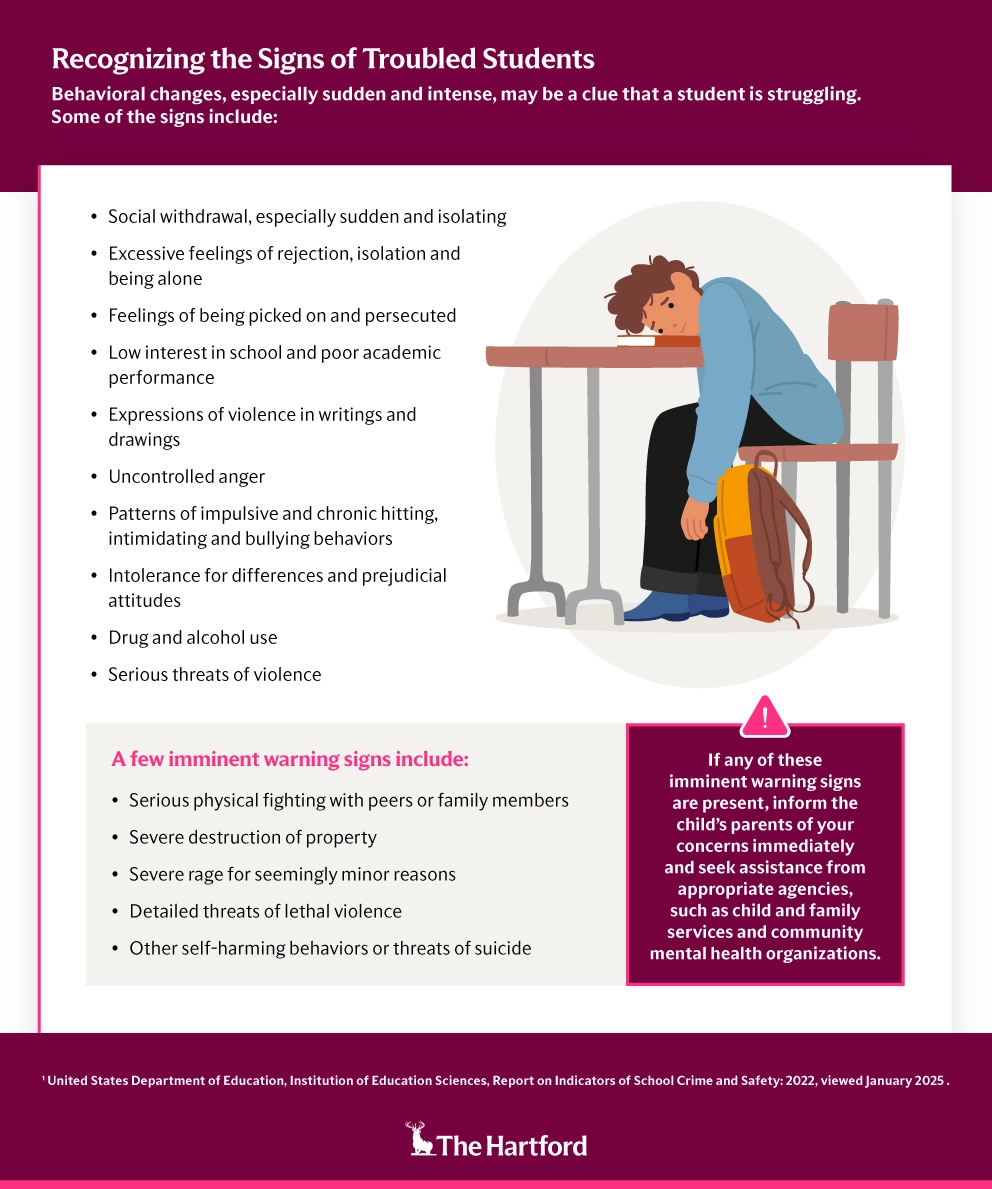
Recognize Warning Signs
Nearly 68% of teachers surveyed say they’ve experienced verbal abuse from a student.6
Professional development training for teachers and staff can help them identify and address students with behavioral or emotional problems that could lead to potentially dangerous situations. Especially troubling are students who exhibit extreme changes in personality or behavior.
“While behavioral or emotional problems don’t necessarily result in school violence, they are indicators that the student needs help,” Whitten explains. “Being able to recognize those signs and proactively offering ways to help can be critical to student safety.”
Explore Violence Prevention Programs
In a national survey conducted by the U.S. Department of Education, 100% of student participants reported experiencing, witnessing or being aware of acts of bullying.7
Evidence-based violence prevention programs have been shown to decrease violence and reduce negative behaviors, especially when supported by social emotional learning components. Some of these include:
- Anonymous reporting systems, like the Say Something program from Sandy Hook Promise. These are tip lines that allow students and staff to share a concern about a safety threat or a classmate at risk of self-harm or in danger.8
- Social-emotional learning programs that promote teaching emotional regulation and conflict resolution strategies alongside other subject matter. 9
- Restorative justice practices that emphasize bringing together all parties in a conflict to address the issue and heal relationships, strengthening belonging and accountability.10
- Whole-school bullying prevention that mobilizes staff and students with ideas to discuss bullying and apply it to lessons in the curriculum.11
Create a Property Safety Plan
Nearly 60% of safety incidents occur outside classrooms, in hallways, parking lots and sports fields.12
Monitoring school buildings is an essential part of overall safety. When reviewing, updating or creating a school security plan, consider these suggestions:
- Keep entry points locked, controlling outside access with a buzz-in system.
- Monitor visitors and ask them to sign in and out.
- Report strangers who don’t have identification or seem suspicious.
- Install alarms that offer full perimeter protection and interior motion detection. This can include silent alarms for offices or out-of-the-way areas.
- Install metal detectors if appropriate for your school.
- Employ on-site security staff or a School Resource Officer (SRO) assigned by your local police department.
- Ensure proper training of officers or other security personnel in various subjects like school psychology, conflict resolution, and federal and state laws about child abuse or neglect.
- Develop guidelines for violent incident response and hold crisis exercises and drills.13
Involve Community Resources
Over 700,000 young people are treated and released in U.S. emergency departments each year for injuries resulting from violence.14
A school’s community has a vested interest in creating a safe environment for learning. Whitten suggests tapping into the broader school community for education and support. There, students and staff may find systems for referring victims of suspected abuse or neglect, such as extended before- and after-school programs. Local, state and federal grants may be available for school violence prevention programs.15 Schools should continuously assess challenges, monitor progress toward solutions and support students as they transition to adult life and the workplace. These strategies not only help prevent violence but also nurture resilience and positive relationships within the school community.
Mitigate Financial Risk With Specialized Insurance
Is your school protected from the various risks it may be exposed to? Our dedicated Risk Engineering team can work with your agent or broker to get you the coverage your educational institution needs. The Hartford offers loss control services to help you reduce risks, plus a variety of insurance solutions to help protect your school from unexpected challenges.
Learn more about our insurance solutions for educational institutions.
1 RAND, “Addressing the Fear of School Violence Is Its Own Policy Challenge,” viewed January 2026.
2,3 The Educator's School Safety Network, “Violent Threats and Incidents in Schools: An Analysis of the 2024-2025 School Year,” viewed January 2026.
4 Education Week, “School Shootings This Year: How Many and Where,” viewed January 2026.
5 Pikmykid, “Trend Report: Voices from the Front Lines of Education,” viewed January 2026.
6 National Education Association, “Breaking the Cycle of Bad Behavior,” viewed January 2026.
7 National Center for Education Statistics, “Student Reports of Bullying: Results From the 2022 School Crime Supplement to the National Crime Victimization Survey,” viewed January 2026.
8 National Institute of Justice, “Tip Lines Can Lower Violence Exposure in Schools,” viewed January 2026.
9 Learning Policy Institute, “Evidence for Social and Emotional Learning in Schools,” viewed January 2026.
10 University of San Diego Professional and Continuing Education, “6 Restorative Justice Practices To Implement in Your Classroom,” viewed January 2026.
11 StopBullying.gov, “Prevention at School,” viewed January 2026.
12 [prnewswire.com], viewed January 2026.
13 The National Association of School Psychologists, “Conducting Crisis Exercises and Drills,” viewed January 2026.
14 Centers for Disease Control and Prevention, “Web-Based Injury Statistics Query and Reporting System,” viewed January 2026.
15 Office of Justice Programs, “FY25 Student, Teachers and Officers Preventing (STOP) School Violence Program,” viewed January 2026.
The information provided in these materials is intended to be general and advisory in nature. It shall not be considered legal advice. The Hartford does not warrant that the implementation of any view or recommendation contained herein will: (i) result in the elimination of any unsafe conditions at your business locations or with respect to your business operations; or (ii) be an appropriate legal or business practice. The Hartford assumes no responsibility for the control or correction of hazards or legal compliance with respect to your business practices, and the views and recommendations contained herein shall not constitute our undertaking, on your behalf or for the benefit of others, to determine or warrant that your business premises, locations or operations are safe or healthful, or are in compliance with any law, rule or regulation. Readers seeking to resolve specific safety, legal or business issues or concerns related to the information provided in these materials should consult their safety consultant, attorney or business advisors. All information and representations contained herein are as of January 2026.
Links from this site to an external site, unaffiliated with The Hartford, may be provided for users' convenience only. The Hartford does not control or review these sites nor does the provision of any link imply an endorsement or association of such non-Hartford sites. The Hartford is not responsible for and makes no representation or warranty regarding the contents, completeness or accuracy or security of any materials on such sites. If you decide to access such non-Hartford sites, you do so at your own risk.
The Hartford Insurance Group, Inc., (NYSE: HIG) operates through its subsidiaries, including the underwriting company Hartford Fire insurance Company, under the brand name, The Hartford,® and is headquartered in Hartford, CT. For additional details, please read The Hartford’s legal notice at https://www.thehartford.com