

The construction and maintenance of roadways and bridges keep vehicles moving swiftly across the country. And yet, the areas around these projects are inherently dangerous to both road crews and traffic passing through.
Work zones cause disruptions to traffic patterns, narrow the roadways and change speed limits. These factors can result in crashes, injuries and fatalities.
The National Work Zone Safety Information Clearinghouse reports that in 2023 alone, an estimated 101,000 work zone crashes resulted in 899 deaths (of which 176 were pedestrians and crew) and more than 39,000 injuries.1
Many of these types of accidents are preventable if both the crews and passing drivers follow safety best practices. To help increase understanding of work zone safety, the American Traffic Safety Services Association (ATSSA) established National Work Zone Awareness Week. The annual campaign is held at the start of spring construction season to encourage safe driving through highway work zones.
“We all need to pay full attention on roadways, especially when traveling in a work zone,” says David DeSilva, head of construction at The Hartford. “The people who fix our roads and build our bridges deserve to do their job safely. Providing motorists with clear guidance through work zones can help reduce risks for everyone.”
The Importance of Traffic Control Plans
Traffic safety begins with a traffic control plan designed to safely transport motorists through a work zone. These plans can vary in detail based on the complexity of the project and should be completed for all maintenance operations and highway construction. Management or supervisory personnel should prepare this plan and account for all variables. Supervisory personnel can find more information on what to include in these plans by visiting their state’s department of transportation website as well as the Federal Highway Administration.
Establishing a Traffic Control Zone
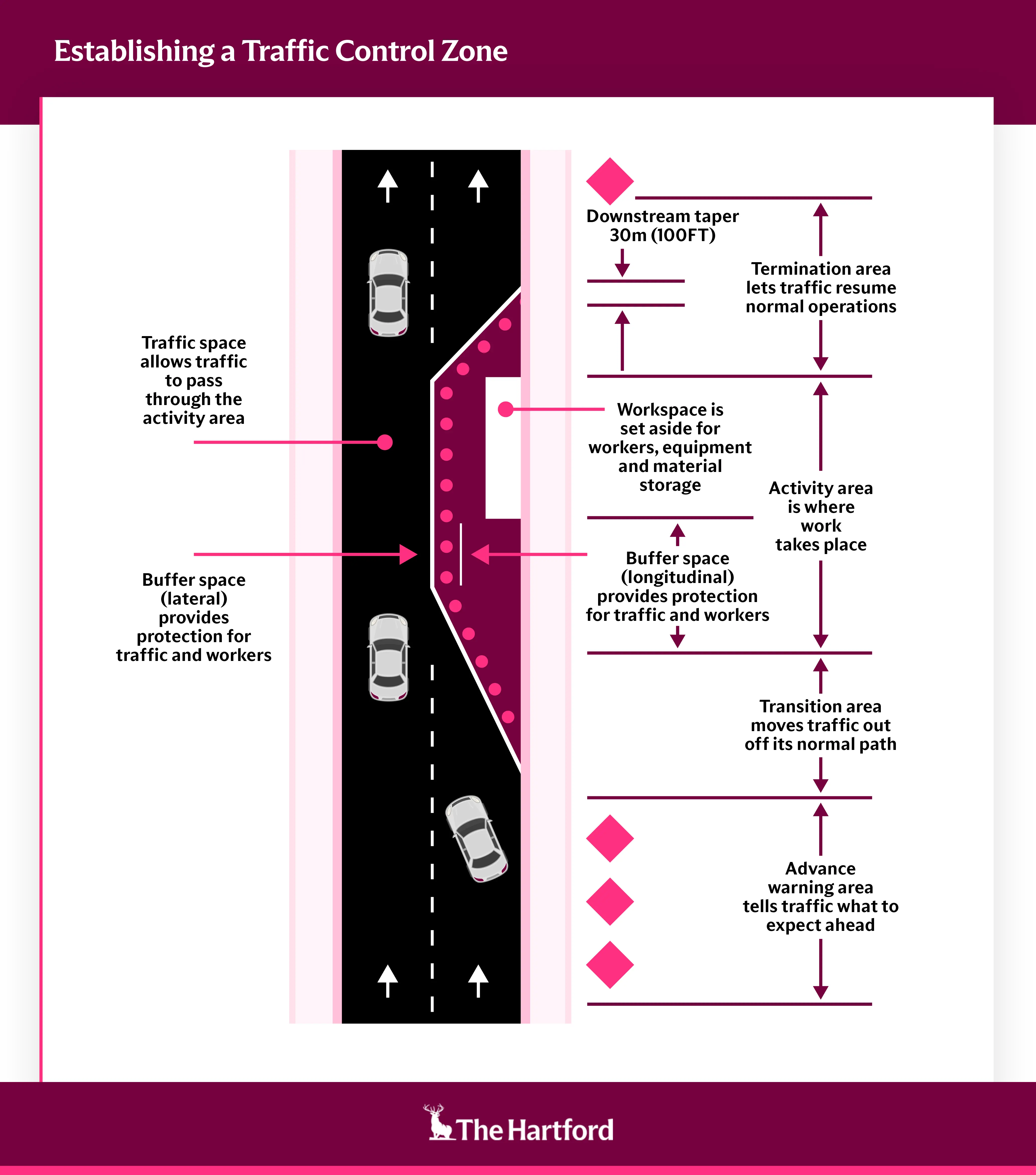
Crucial to a traffic plan are traffic control zones that direct the flow of vehicles and pedestrians around construction and maintenance projects. This step ensures the safety of crew, drivers and pedestrians by designing temporary traffic control zones divided into four areas:
- The advance warning area, where motorists are informed of the upcoming road work with signs, arrow panels or message boards.
- The transition area that redirects road users from their normal path away from the work zone.
- The activity area where the work activity takes place, including an area set aside for workers, equipment and materials and an additional buffer that separates moving vehicles from the workspace.
- A termination area that extends beyond the work zone and returns traffic to its normal flow via cone placement as a visual guide to drivers.
A Safety Strategy Toolbox
According to a 2025 national survey, 60% of highway contractors experienced at least one work zone crash in the past year.2 The responsibility for reducing these numbers starts with engineers, planners, crew supervisors and employees.
“Heading into a roadwork project without the right planning for safety is an accident waiting to happen,” says DeSilva. “The entire team needs to do their part to follow injury prevention measures and adhere to protocol to keep everyone safe.”
We’ve compiled key information to help guide the various roles in a road construction project.
For Engineers, Planners and Contracting Agencies
- Assess contracts using criteria beyond simply a low bid.
- Require potential contractors to include a written safety program and appropriate protective systems (e.g., truck-mounted attenuators or concrete barricades).
- Specify minimum lighting levels, types of light sources and minimum areas to be illuminated.
- Pre-qualify all contractors and subcontractors to ensure that they have acceptable safety records.
- Use clear language in contracts that holds companies to specifications, and assign temporary traffic control responsibilities to a supervisor on-site.
- Look for safety programs that incorporate technology‑enabled monitoring or data analysis tools that support proactive risk identification across fleets, equipment and work zones.
For Management and Supervisory Personnel
- Develop traffic control plans (TCPs) for all medium, large and multi-contractor jobs and document them in writing. For small, recurrent operations such as filling potholes, routine maintenance and mowing, a verified safety checklist may be used.
- Ensure trained traffic control coordinators are present at each jobsite with the authorization to temporarily halt work, if necessary, until unsafe conditions have been eliminated.
- Hold “toolbox” meetings at the jobsite to discuss and report hazards and near misses. Be sure to also discuss safety considerations that are needed to perform the tasks.
- Evaluate the effectiveness of the temporary traffic control on a regular basis by visiting the work zone and looking for evidence of near misses, like skid marks or damaged barricades.
- Consider the use of data‑driven risk management tools — such as telematics, video analytics or connected‑device technologies — to help identify driving behaviors, equipment movement patterns or near‑miss trends that may not be visible through periodic jobsite observations alone.
- Where worker exposure to traffic cannot be eliminated, use positive protective barriers (e.g., temporary traffic barriers) to shield workers from intrusions by traffic vehicles.
- Train flaggers according to their level of responsibility and work zone conditions in line with applicable state department of transportation requirements. Refer to The National ATSSA Train the Trainer Flagger Registration Program for a listing of state flagger requirements.
- Avoid using flaggers under hazardous conditions, such as high traffic speeds, inclement weather, night work and other conditions that limit visibility.
For Employees Working in Work Zones
- Wear high-visibility safety apparel in work zones. Inspect apparel regularly and report and replace damaged or defected clothing.
- Perform pre-shift equipment checks and report any deficiencies. Pictorial equipment checklists make equipment inspections easier.
- Read operator manuals prior to use and only move equipment after making positive visual contact with any workers on foot or near the equipment.
- Set parking brakes when leaving equipment unattended, and chock wheels when equipment is parked on an incline.
- Question any portion of the TCP that you don’t understand.
Responsibility Is a Team Goal
Work zone safety requires risk management strategies that fit the unique needs of each road construction project. From the engineers who design the work zones to the supervisors and crew who follow the protocol, keeping everyone safe is a team effort. When proactive strategies and compliance are encouraged across all construction segments, the roads can become safer for all.
For additional guidance, consult our risk mitigation resources and refer to our TIPS. For more risk management strategies, visit our construction page.
1 National Work Zone Safety Information Clearinghouse, “Work Zone Data,” viewed March 2026.
2 Associated General Contractors of America, “2025 AGC and HCSS Highway Work Zone Safety Survey,” viewed March 2026.