Picture a large, complex society made up of entities that burrow through your yard, swarm around your doors, and lurk in your house for years, patiently eating away at your walls – causing damage that you’re not even aware of. This isn’t the plot of some awful horror movie. It’s a common ordeal faced every day by homeowners across the nation: termite infestation.
According to the United States Environmental Protection Agency (EPA), “every year termites cause billions of dollars in structural damage, and property owners spend over two billion dollars to treat them.” But as common as the problem is, it can be difficult to tell whether your home has a termite issue. Treatment options can also be confusing – or even dangerous.
Wondering how to spot termites on your property and what to do if you find them? Here are some basic tips.
Types of Termites and Where They Live
The types of termite found in the United States are the:
- Eastern subterranean termite (Reticulitermes flavipes): This is the most common termite species in the U.S. Subterranean termites tunnel through the earth to reach food sources above ground. They can build mud tubes along exterior walls in order to access moist wood that doesn’t make contact with the ground.
- Drywood termite (Incisitermes snyderi): The second most common termite species typically can be found in the coastal South and the Southwest. Drywood termites live in places like walls, decks, fences, and furniture, and are also commonly discovered in attics.
- Dampwood termite (Zootermopsis angusticollis): This termite inhabits decaying wood and is found along the West Coast, in the Southwest, and in Florida.
- Formosan termites (Coptotermes formosanus): This type of subterranean termite is found in Hawaii and a number of Southern states. They are known for being particularly aggressive and destructive.

How to Identify Termites
In North America, there are dozens of species of termites, and they vary in size, color, and shape. Usually, termites are about one-fourth to one-half inch long, although kings and queens may be longer than one inch.
Termites are often confused with flying ants. But for you amateur entomologists, there are a few differences to look out for:
- Ants’ front wings are longer than their back wings; termites’ front and back wings are equal in length.
- Ants have antennae that bend at a 90-degree angle; termites have antennae that are straight or drooping.
- Ants have a narrow waist, but termites do not.
Your state’s government or university extension program may provide additional resources to help you identify termites. For example, the Maryland Department of Agriculture offers regionally appropriate information.
Termite Behavior
Termites live in colonies, which are split into castes that perform different functions:
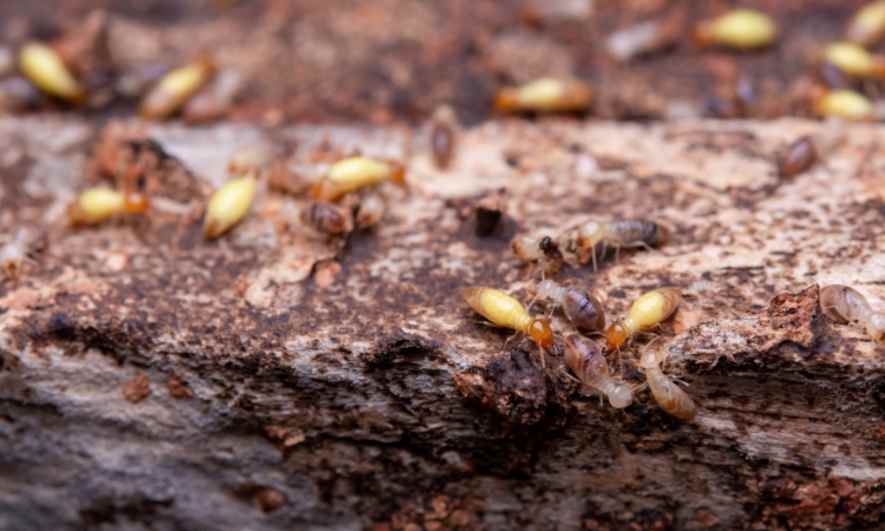
- Workers have soft, light-colored bodies. They cause most wood damage.
- Soldiers are yellow-brown with large heads and jaws. They defend the colony.
- Reproductives are darkest and have two pairs of wings. After they mate, they lose their wings and become the kings and queens of their new colonies.
All types of termites eat cellulose-based plant materials (i.e., trees and plants, either living or dead). They also eat paper, drywall, and other materials, and can chew their way through books, furniture, and even the foundation of a house. Different types of termites prefer different environments and diets, as the names “drywood termite” and “dampwood termite” suggest.
Signs of Termites
When they recycle dead timber in the forest, termites are beneficial to the environment. But when they come in contact with human homes, termites are destructive. They can cause major damage to wooden structures, metal siding, and plastics.
If you see flying termites or break open a mud tunnel to find subterranean termites within, that’s a clear cause for concern.
But termites can be present on your property for years without showing themselves or causing visible damage. Absent any obvious signs, how can you tell whether you have termites?
- Use a screwdriver to examine exposed wood for hollow spots.
- Knock on wood structures, listening for a hollow sound.
- Inspect places where concrete and wood meet.
- Pay special attention to the wood in basements and under porches.
- Check fences and tree stumps.
- Look out for wings. Flying termites lose their wings after they swarm in the warmer months. These wings can signal a new colony of termites.
- Unexplained piles of small pellets could also indicate a termite presence as they could be termite frass, or droppings.
How to Deter Termites
One of the best ways to deter termites is by planning ahead. If you’re constructing a new addition or home, cover exposed sections of wood with a sealant. And avoid direct contact between the wood of your house and the soil to curtail any future problems.