As a small business owner, you may reach a point where you’re thinking about new equipment or assets to help grow your company. The challenge is knowing if the investment will bring a return.
That’s where net present value (NPV) helps. At its simplest, NPV looks at the future cash flow an asset is expected to generate and then discounts it to today’s value. After these
discounted cash flows are added up, you subtract the initial investment, or cost of the asset. This calculation gives you the net profit value definition in action.
So, what does NPV stand for in finance? It means “net present value,” a method used to determine whether projected cash flows are worth more than the money you spend up front.
By showing you whether the value of future cash flows outweighs the initial cost, NPV gives you a practical way to evaluate potential investments and understand their long-term impact.
Using net present value has several advantages that make it a practical tool for evaluating investments:
- Compare Projects: NPV makes it easier to weigh projects with different time frames and cash flow patterns by putting them on the same financial basis.
- Support Decision-Making: It provides a straightforward way to see if future returns are likely to outweigh costs, helping you make more informed choices about whether to move forward.
- Account for Time Value of Money: NPV incorporates the fact that a dollar today is worth more than a dollar in the future, giving you a more accurate picture than methods that don’t account for changing value over time.
NPV is a valuable tool that not only highlights whether an investment is likely to pay off, but also gives you a clearer, more reliable basis for comparing options and planning for long-term growth.
So how do you calculate NPV?
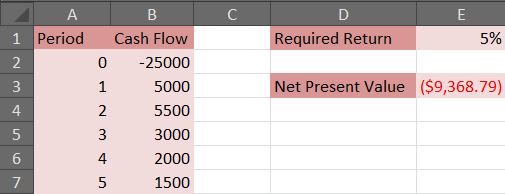
There are two formulas to calculate the net present value — the formula you use depends on the type of cash flows. If the cash flows are the same each year, you use an annuity formula. If they vary, you discount each cash flow separately.
For equal yearly cash flows, apply the annuity formula:
R x ((1-(1+i)-n)/i) - Initial Investment
- The R represents the net cash flow for each time period.
- The i is the discount rate that will be used to find the present value of the future cash flows. The discount rate can also be thought of as the desired rate of return you could get on your investment.
- The n represents the time period you’re looking at to value the asset.
For varying yearly cash flows, the calculation changes. This is where people often ask, “What is the net present value method?” since it applies when cash flows differ over time. In that case, use this formula:
(C for Period 1 / (1+r)1) + (C for Period 2 / (1+r)2 + … C for given time period t / (1+r)t) - Initial Investment
- The C represents the cash flow for the given time period.
- The r represents the discount rate, or your desired rate of return.
- The t represents the time period.
In this formula, each projected cash flow is discounted to the present, added together and then reduced by the initial investment. The result is the net present value.
What Is a Net Present Value Example?
A common question that business owners ask is: What is NPV in finance and how does it look in practice? Here’s a simple example.
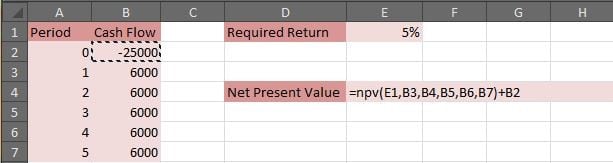
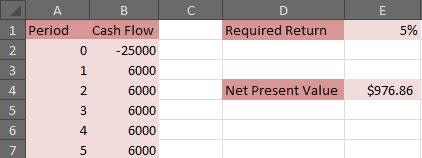
Imagine you’re evaluating a potential purchase. The equipment you’re considering costs $25,000, and over the next five years it’s estimated to generate an additional $6,000 a year. Those yearly projections are the same type of numbers you’d track in a
cash flow statement. With a discount rate of 5%, is it worth the investment once you account for the initial price and other
business expenses?
Because the projected cash flows are the same for each year, you would use the first formula. Here’s how it works: