Day 17: Bathroom
Many products stored or used in the bathroom have relatively short shelf lives, so check expiration dates and make sure your makeup, skincare, and medicines are still good. Also check that you’re not holding on to any empty bottles of soap, shampoo, or cleaning supplies. If you have shelving units, shower caddies, or similar storage containers in your bathroom, consider whether they make the space easier to use or just add to the clutter.
Storage containers can help you corral small items or manage a difficult space (such as a bathroom with no built-in shelves or cabinets). But, more often, we buy these containers without fully considering whether they’re needed, and they soon become clutter themselves. When in doubt, don’t buy storage containers unless you know exactly how and where you’ll use them.
Day 18: Linen Closet
Linen closets, or wherever you store those extra towels, sheets, pillowcases, and blankets, can easily become overstuffed and disorganized. Today, sort through your linens and remove anything that you don’t use. Unless you really keep on top of it, your linen closet can become a black hole of unused, yet useful, items. If you find you’re creating extra space in your linen closet, you may choose to store seasonal linens or decorations there, as well.
Day 19: Storage Area of Your Choice
On this day, clear out any indoor storage area that hasn’t been covered yet. This could be a hall closet, a bedroom closet that wasn’t covered in your wardrobe clear-out, a chest, or the space under the bed.
During this seven-day room-clearing section of the challenge, leave the attic, basement, garage, and outdoors alone for now, as you’ll get to them later – unless, of course, you have some extra time and really feel like tackling them.
Today, clear your kitchen of any unused or unwanted items such as cookware, dishes, cutlery, glassware, mugs, utensils, and so on. Don’t forget to assess gadgets and small appliances, like potato peelers or blenders, and be honest with yourself about whether you really use them. Especially be on the lookout for duplicates of items that may be taking up your kitchen storage space. To prevent future kitchen clutter, organize those items you do use regularly so that everything is easily accessible.
Day 21: Dining Room
Dining room clutter is usually made up of items that drift in from other rooms. Today, grab anything that doesn’t belong here and return shoes to the closet, mugs to the kitchen, etc. You may also have too much dining room furniture, especially if you downsized from a larger space or have fewer people living with you and visiting than in the past. If you have 10 chairs and never host more than four people, those extra chairs may now be functioning as clutter, and you might be better off without them.
If your home or apartment doesn’t have a separate living room and dining room, you can either adapt Days 21 and 22 to cover other rooms, or split your space into sections. In a one-bedroom apartment, for example, your “dining room” can be the area where you eat (even if it’s just a table) and your “living room” may contain a couch, coffee table, and TV stand.
Day 22: Living Room
Much like the dining room, the living room can collect things that people bring from elsewhere and forget to put away. Scan the room for this type of clutter, being careful not to miss out-of-place items that have been lying around so long that you don’t normally notice them. Depending on how often you actually use your living room, you may find a variety of rarely used items cluttering up the space.
Day 23: Your Personal Clutter Hotspot
This day is another wild card to allow for the quirks of your space and your life. Many homes have a tricky no man’s land where clutter builds up, like the stairs or a little corner nook; you may also have a room not covered in this challenge, like a laundry room or sunroom. Alternately, you can take this day to deal with a clutter hotspot outside your home, like your desk at work, or to revisit any of the prior topics that didn’t get fully addressed in one day.
Day 24: Attic and Basement
You might think the expression “out of sight, out of mind” would apply to clutter – after all, it’s easy enough to shove any objects we don’t want to make decisions about into one of these spacious storage areas. But just being aware that there’s a mess of stuff hiding above or below can be a subtle source of stress. Venture downstairs or upstairs today and sort through those items you’ve stashed away. You may find many things that were difficult to part with at the time, but that you’re now happy to get rid of.
Day 25: Car
Most of us spend so much time in our cars that, if we’re not vigilant, they can end up filled with junk, like empty coffee cups, and misplaced items, like scarves or books. The good news is, it doesn’t take too long to clean out your vehicle, so do that today.
If you don’t have a vehicle or any outdoor storage areas, consider taking this day and Day 26 to start planning a
yard sale to get rid of the items that didn’t make the cut in this challenge.
Day 26: Outdoor Areas
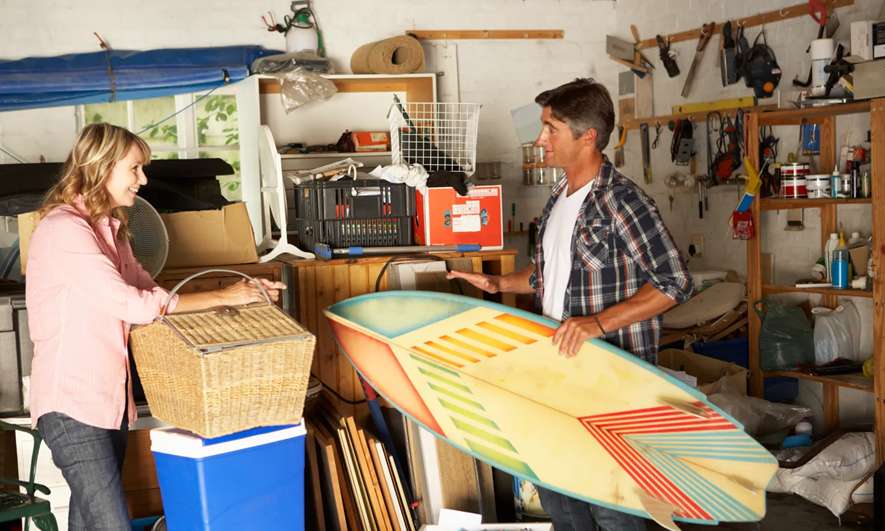
If you have a garage, shed, porch, steps, or any other outdoor area that’s a magnet for clutter, take this day to sort through everything that’s out there. If you’ve recently moved or downsized, you may have donated or gotten rid of a lot of the items that tend to live in these spaces, but, if you haven’t, clearing cluttered outdoor areas can be a real game-changer. Organize the things you use, and get rid of the things you don’t.
Day 27: Pet and Plant Supplies
With pets and plants come toys, food containers, tools, gloves, and other necessary (and not so necessary) accessories. If you haven’t already dealt with these things on another day, figure out which stuffed toys or terracotta pots you still want, throw out anything that can’t be used, and pass the rest on to another pet- or plant-lover.
Day 28: DIY and Emergency Supplies
You may have encountered some of these in your junk drawer or elsewhere, but today is the day to round up and sort out all the little things you reach for when something needs fixing: batteries, light bulbs, tools, user manuals, tape, screws, hooks, buttons, scissors, needles, thread, and other assorted household bits. Also check out your
emergency supplies like flashlights, candles, and matches. Your goal is to organize everything so that it’s readily accessible when you need it, and, of course, to discard anything that’s broken, expired or that you’ll never use.
Day 29: Hobby Equipment and Collections
You may not want to get rid of any of your art supplies, exercise equipment, DVDs, or souvenir refrigerator magnets. But you should go through it all anyway, because – despite your best intentions – collectibles and hobby equipment and supplies can quickly become unmanageable clutter. You may discover that you don’t really use every item you own, or that you’re holding on to some things that no longer make you happy. If so, consider gifting these items to family or friends or donating them to someone who will use and enjoy them. Even if you keep it all, simply reorganizing these items can seriously clear up space in your home, making it easier for you to practice your hobby or appreciate the objects you’ve collected.
Email might not seem like something you need to declutter – after all, it doesn’t take up physical space. But repeatedly opening an inbox full of messages you haven’t read or acted on can really drain your energy, making you less productive. Delete what you don’t need, flag what you have to take care of, and save messages you want to preserve to the appropriate folder. (If you don’t have separate folders, create some now.) There are also tools to maximize your email enjoyment and productivity. You can also choose to expand this virtual decluttering to your contacts list, digital photos, documents, music, social media, or anything online that makes you feel overwhelmed.
This last day also can serve as inspiration to declutter your physical environment further, or to move on to the next level of decluttering and revamp your schedule, the activities you participate in, and the people you choose to make time for. Once you start the decluttering process, it will become easier to manage the daily inflow of stuff – helping prevent the accumulation of new clutter and making your life run more smoothly overall.
And now, 30 days later, you’re done! Or, even if you’re not done, you’ve made a tremendous start. If you’re living in a home where you’ve stayed for more than 20 years, you may find that this 30-day declutter challenge equals round one, rather than the end game. Take a break if you need to, and then pick a new month and begin again.