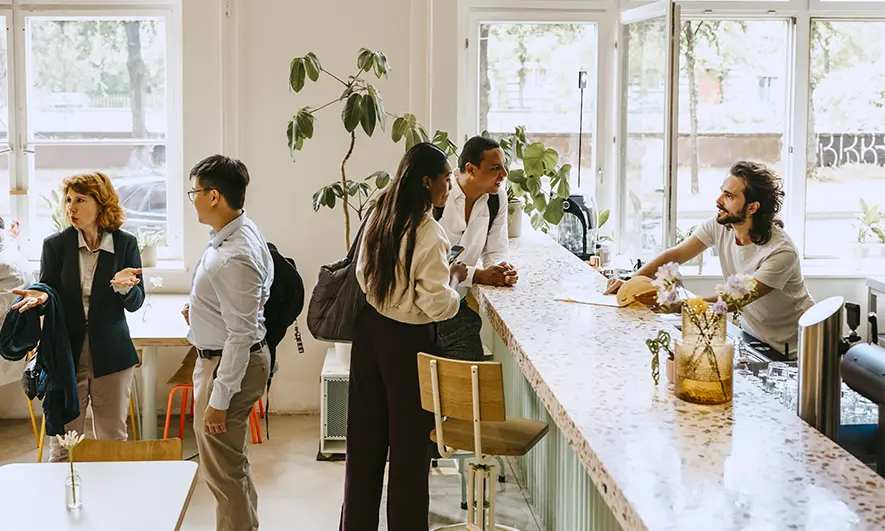
The numbers right now are rough. January marked the 12th consecutive month in which customer traffic was down across the small-business restaurant industry, according to The National Restaurant Association.1
Many small business owners are reporting declines in traffic compared to last year. A 2025 YouGov survey found that almost 70% of diners who aren’t eating out as much blame rising living costs.2
Here are five ways small businesses can increase foot traffic without a big budget or a dramatic overhaul.
The most reliable, frequent customers are those who live and work within a few miles of your small business’ front door. Draw a five-mile circle on a map and get curious. Is there an office park that empties out at lunch? What about a college campus or a new residential building? Each one of these is an opportunity for specific, personal outreach.
A student discount, a catering pitch or a welcome flyer could go a long way. These things aren’t complicated, and even though they don’t feel like marketing, they are the most effective kind.
It’s easy to accept the slow periods and chalk it up to, “This is just how it is.” But the restaurant owners who break out of that pattern are giving people real reasons to come and visit — not with generic discounts, but with events that have identity. A trivia night or a taco Tuesday can help build a habit for your customers.
Research in behavioral science consistently shows that habits turn one-time customers into regulars, and regulars are what keep small-business restaurants alive.3
Connecting with your community has to be active, not passive. You should make an effort to partner with nearby businesses, offer your space for a local non-profit’s event or even sponsor something the people in your community care about.
When consumers are deliberate about where they spend their time and money, they choose places that hold a sense of community and belonging. Every genuine relationship built within the neighborhood becomes a referral engine that can be replicated.
Most of your potential customers will interact with your small business online first, even before they try your food. This includes your Google profile, Instagram and even your reviews. Bank of America’s State of the Restaurant Industry report showed that loyalty-connected sales were up nearly 34% in 2024, while non-loyalty sales barely changed.4
The best thing to do is set aside an hour this week and use that time to update your phone number, confirm your hours on Google, respond to a few reviews (yes, even the bad ones) and make sure any loyalty program you offer is visible and easy to join. Small moves will add up fast and get more people in your actual front door.
If you have a point-of-sale (POS) system, you’re sitting on a gold mine of information. Which menu items drive the most orders? What time of day does your foot traffic drop? Are you properly staffed during your busiest hours? All of that data should drive your decisions about staffing, specials and promotions.
The small-business restaurant industry is going through a genuinely hard time, but the owners who come out on top are almost always intentional about the fundamentals. They are the ones who take action even when things feel uncertain.
1 National Restaurant Association, “Same-Store Sales and Customer Traffic,” viewed May 2026.
2 YouGov Survey, “Foodservice Traffic Continues To Fall as Consumers Cut Costs,” viewed May 2026.
3 PLOS, “Influences of atmospherics on customer satisfaction and behavioural intentions in the restaurant industry: Evidence from an emerging economy,” viewed May 2026.
4 Bank of America’s State of the Restaurant Industry report, viewed May 2026.