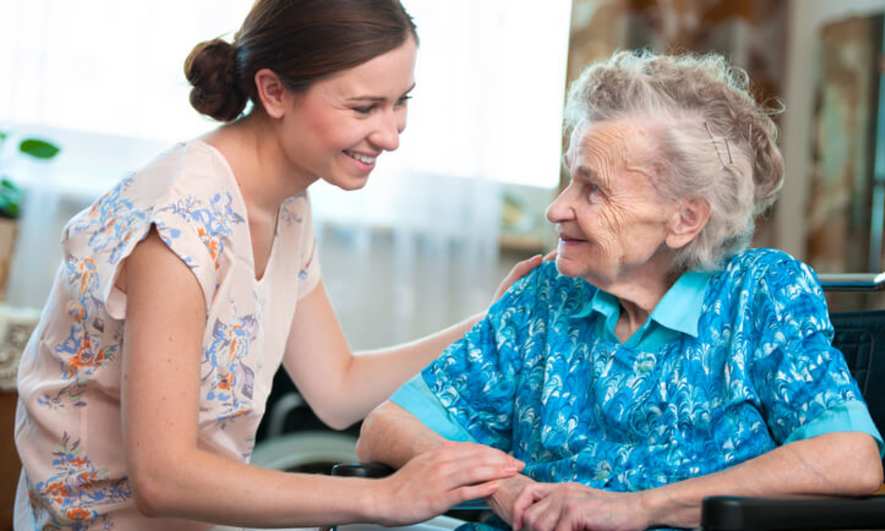

Caregiving relationships are not always easy to navigate. Learn how to support someone in your care while recognizing and managing your own feelings of grief. An advertisement for home care or assisted living pops up on your screen. Two people, often assumed to be an aging parent and an adult child, are smiling, walking down a long hallway with arms linked. Or they’re sitting side by side on a couch.
Caregiving is often portrayed as a loving relationship between a parent and adult child. But this isn’t the reality for everyone.
“The image of the loving relationship between a care partner and their ‘loved one’ is not as common as we are led to believe,” says Pamela Corsentino, a licensed professional counselor. “People come into the care dyad with a relationship history which is not often idyllic.”
The Role of Grief in Complicated Care Relationships
The reasons for these complicated relationships are as varied as the people in them. Kimberly Nelson, a clinical social worker and psychotherapist, believes there’s a strong connection to grief.
“It may be particularly difficult if the caregiver themselves is grieving too,” says Nelson, who specializes in international adoption and grief. “The caregiver is experiencing complicated grief and now has an additional role to fill.”
Types of Complicated Grief
What does that complicated grief look like? It’s different for every person. For those asked to care for a parent, spouse, ex, or relative with whom there’s a strained relationship, there’s grief over the circumstances that led to the strained relationship.
This could be either past or present. There may be feelings of guilt about wanting to say no to providing care, especially for someone who may not have provided adequate care in return, while also not wanting to abandon that person during a time of need. Other feelings may include resentment for being put in the position to decide about providing care, fear about being connected with a person who is or has been toxic, and potentially, anger over being the one who must be responsible.
Nelson says the caregiver may also be experiencing disenfranchised grief, which is grief that is "not openly acknowledged, socially validated, or publicly supported." The term was introduced by sociologist Kenneth J. Doka to describe losses that are not fully recognized or validated by society.
When Complicated Grief Surfaces
For many who find themselves in complicated relationships, this grief may not surface until they’re plunged into a caregiving situation. Often this happens with little choice or time to prepare. Soon, the difficult decisions facing a newly minted caregiver disrupt what may have been a stable relationship. This can be the case even if it wasn’t a positive or thriving one.
This was the case for Hayley Croom, a small business owner from York, Pennsylvania, who is now the power of attorney and sole family contact for her 79-year-old mother with Parkinson’s.
“We’ve never had an easy relationship, and I’m working through the realization that she (and both of my dads) have narcissistic-type behaviors and have emotionally neglected me since childhood,” Croom says.
Croom’s mother was recently admitted to full nursing care. She alternates between praising her daughter for her ability to manage everything and raging at her for putting her into nursing care, walking the line between lucidity and delusion, Croom says. “Some days it’s hard to tell which is which.”
Why Managing Difficult Care Is a Family Affair
Whether you’re an only child or have siblings, there are a variety of stressors that can contribute to a strained caregiving situation:
- Maybe you’re responsible for the care decisions, not by choice but by practicality or geographic proximity, and a sibling disagrees with the way you’ve managed a parent’s care.
- Perhaps a parent remarried later in life and cut off contact with you and your siblings, favoring the new spouse’s children instead.
- Maybe a parent was abusive, but your siblings or other family members don’t know about the history of abuse and don’t understand why you don’t want to take responsibility for care.
In other cases, the stressors come from the other side of the equation:
- Sometimes, adult children want to provide care or support, and a new spouse or partner blocks their efforts and intentions.
- In some cases, adult children are willing to help. They may even be willing to partner with siblings from whom they’ve been estranged. But a parent or relative rejects help because of a difficult diagnosis.
- Sometimes, adult children disagree with a parent’s decision to care for an ex-spouse.
Navigating Strained Care Situations
These are just several examples of strained care situations, and each one brings its own challenges, grief and hardship. Money also plays a part, as ex-spouses may be entitled to certain retirement or Social Security benefits.
“I have had clients on both sides of this situation, and it is tough,” says Corsentino. “Working through and past these experiences is key to reducing the stress and negative emotions during the care journey.”
After her stepfather filed for divorce in the months leading up to her mother’s transition to a nursing home, Croom was “left holding the proverbial bag.” She was fully responsible for her mother’s medical care, housing, finances and legal concerns.
How to Cope with a Complicated Caregiving Situation
If you’re in the midst of caring for a person with whom you have a complicated relationship, Corsentino and Croom recommend seeking support from two key professionals: an elder law attorney and a therapist.
Estate planning, financial and legal considerations, advanced directives and paying for long-term care can be complex. This is especially so in a family with conflicts. Although many believe they can’t afford to pay for an elder law attorney, Corsentino says “you can’t afford not to have one.”
For Croom, weekly therapy has been a lifeline. It helps her manage the immediate emotions of the situation and process the long-term dysfunction in her relationship with her mother.
“With my therapy tools, I’ve been able to identify and set some really big, very firm boundaries that have kept me from becoming completely consumed by my mother’s chaos,” Croom says.
Learning From Complicated Caregiving
Although a complicated caregiving relationship can bring emotional and practical challenges, it may also offer opportunities for personal growth, deeper understanding, and meaningful life lessons.
Croom learned she was not alone in caring for a parent when the reality of the experience looked very different from the idealized portrayals often associated with aging and caregiving.
“Once I started talking transparently about my experiences, I was surprised how many other people are caught in a similar situation with their parents in one form or another,” she says.
One of the lessons Croom learned is that help may be more available than many caregivers realize. The challenge is often knowing where to find it. “We’re only at the facility we are because of a hospital social worker’s casual comment; otherwise, I would never have even considered that we’d be able to afford it,” she says. This experience highlights the value of seeking home- and community-based resources, whether they are offered locally, statewide, nationally, or virtually. Connecting with a hospital social worker, discharge planner, or other trusted professional can be an important first step in identifying resources that meet your family's needs.
Croom also learned the importance of talking openly about finances before caregiving becomes a reality. While these conversations can be uncomfortable, they can help prevent unexpected challenges and give families more time to plan, prepare, and make informed decisions together.
Not All Caregiving Roles Look the Same
Caregiving is often portrayed in narrow or idealized ways, but the reality is far more diverse. Providing care can take many forms, and direct, hands-on assistance is just one of them. As Corsentino notes, not every person needs daily personal care, and not every caregiver is in a position to provide it.
Whether you are managing finances, coordinating services, providing emotional support, or assisting with daily needs, each contribution helps support the well-being of another person. Being the primary, hands-on caregiver is one role among many, not an obligation.
Takeaways for New Caregivers and Care Partners
There are no easy answers when you're navigating caregiving relationships affected by grief, trauma or estrangement. You may never come to a place of reconciliation or resolution. However, you can and should protect yourself with self-compassion, boundaries, and an openness to change, from either side.
“Figure out what you're honestly willing to do for the long term,” Croom says. “Consistency is vital in managing expectations and maintaining your boundaries, and jumping in to do everything when you know you can’t keep it up is a recipe for burnout and crisis.”
Croom reminds others in complicated care partnerships that big feelings are totally normal.
“Know that it’s okay and healthy to have really big, complicated feelings about your role; it’s okay to be angry, sad, guilty, resentful. This is an incredibly hard situation. It’s important to give yourself space to feel all the emotions it will trigger.”