The net present value and
discounted cash flow (DCF) analyses can be used together to help you make an informed decision. But they’re not the same. The discounted cash flow analysis helps you determine how much projected cash flows are worth in today’s time. The Net Present Value tells you the net return on your investment, after accounting for startup costs.
Both calculations examine your small business’s cash flows, or how much money is taken in and spent.
Net present value calculates your return on investment by looking at how much money generated in the future is worth today, and whether or not those expected cash flows are more or less than your initial investment.
The formula takes the total cash inflows in the future and discounts it by a certain rate to find the present value. You then subtract the initial cost of the investment from the total cash inflows. If the result is greater than zero, then the investment is expected to make a return. If the result is less than zero, then the investment is expected to result in a net loss.
To find the net present value, you’ll need to know three things:
- The amount of the initial investment
- The discount rate, or the desired rate of return
- The period of time being analyzed
There are two formulas to calculate the net present value. Knowing which one to use depends on what kind of information you have.
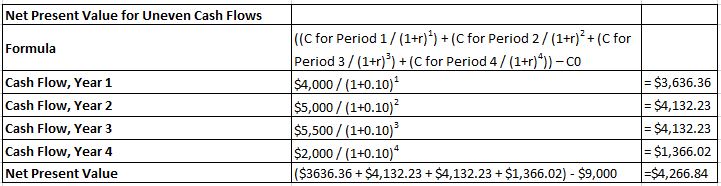
With Different Cash Flows Each Time Period
If the project or asset you’re looking at is estimated to generate different cash flows for each time period, you’ll use this formula:
(C for Period 1 / (1+r)1) + (C for Period 2 / (1+r)2) + … (C for given time period t / (1+r)t) – C0
In the formula above,
- C represents the cash flow that the asset is projected to generate in each time period.
- R represents the discount rate that will be used to find the present value of the future cash flows. The discount rate is the desired rate of return you could get for your money if it were used for a different investment with a similar risk level. The rate could be the interest rate, bond rate, or any other percentage you choose.
- C0 represents the initial investment—or how much money you’ll be spending to make the initial investment.
With the Same Cash Flows Each Time Period
If the project or asset you’re looking at is estimated to generate the same amount of cash flow for each time period, you’ll use this formula:
R x ((1-(1+i)-n)/i) – Initial Investment
In the formula above:
- R represents the net cash inflow for each time period.
- i represents the required rate of return, or discount rate.
- n represents the time period you’re using to value the project or asset.
Regardless of which formula you’re using, if the resulting net present value is a positive number (greater than 0), then the investment is considered valuable, and a good investment. If the resulting net present value is a negative number, then it’s considered to be a bad investment.