Workers’ Compensation Insurance

Get Workers’ Comp Employee Protection
Protect your business from employee injuries and illnesses — all for as low as $13 a month.**
Get My Price
Two smiling small business employees in aprons, representing workers’ compensation insurance for workplace protection
200+
Years Proudly Serving Our Customers
1.3MM+
Small Business Customers
17x
World’s Most Ethical Companies® Honoree by EthisphereE
what is workers comp insurance video

What Is Workers’ Compensation Insurance?

Workers’ compensation insurance, also known as workers’ comp or workman’s comp, gives employees medical, wage and other benefits if they have a work-related injury or illness. Most states require this type of coverage if you have employees.

How Much Is Workers’ Compensation Insurance?

Most of The Hartford’s customers with less than $300,000 in payroll pay an average of $81 a month for workers’ compensation insurance coverage, and some policies can start as low as $13 a month.** Workers’ comp insurance costs vary by state due to local requirements, payroll size and industry risk. Use the tool to see the average cost for small businesses in your state.
$00/mo1
on average
Average Monthly Workers' Compensation Cost for The Hartford's Customers:**
For payroll amount:
Approximate Monthly Cost
~ ?

The Advantages of Workers’ Comp From The Hartford

The Hartford’s workers’ compensation insurance helps protect your employees and your business when a workplace injury or illness happens. Our experienced claims team, digital self-service tools and responsive service support can help employees get the care they need while helping your business stay up and running.

Preferred Medical Provider Network

Access to over 1 million providers experienced in treating workplace injuries.

Prescription Drug Features

Access to more than 65,000 U.S. pharmacies to fill a prescription, usually with no out-of-pocket expenses, plus convenient mail-order service.

Needle Stick Reimbursement Program

Helps cover medical expenses and the initial testing of your employee and their patient if your worker gets hurt from a needle. It can also reimburse your employee for additional testing.

Nursed Back to Health Program

Highly experienced nurse case managers work with your employees to coordinate health care and treatment.

Benefits of The Hartford’s WC Insurance for Employers and Employees

We know getting a workers’ compensation insurance policy can feel complicated. The Hartford makes it easier with tools and services designed to support your business and your employees.

We offer services like pay-as-you-go workers’ comp, so you can pay your premium based on your actual payroll — not an estimate. This can help make payments more accurate and easier to manage.
 
We also provide an easy-to-use digital platform: My Workers’ Comp Connection — designed to keep your employees informed and supported throughout the claims process. 
 
With this portal, injured employees can:
 
  • Check the status of their claim
  • Review payments
  • Sign up for direct deposit****
  • Get a medical services card
Some businesses may need a workers’ compensation certificate of insurance (COI) to help show proof of coverage for contracts, vendors or licensing requirements. Learn how to get a workers’ compensation certificate of insurance for your business.
small business owner giving testimonial on having workers' compensation insurance from The Hartford

Hear From Our Customers

“I've been working with The Hartford for about 10 years now with a Workers' Comp policy … When you call on the phone, if you have a question, everyone is respectful, knowledgeable, they know what they're talking about. And in today's world with insurance, that's not easy … That's why we'd never use anyone else.”
– Ron Grosso, Owner of Blind Owl Wm127, Inc.

Employer’s Liability Insurance and Workers’ Compensation

Workers’ compensation insurance and employer’s liability insurance work together to help protect your business from workplace injury risks. Workers’ comp typically covers an employee’s medical costs and lost wages after a work-related injury or illness. Employer’s liability coverage can help protect your business from certain lawsuits related to incidents that may fall outside standard workers’ comp benefits.
 
Learn more about employer's liability insurance and workers’ compensation coverage.
 

Workers’ Compensation Insurance in Monopolistic States

In four states, businesses are required to get workers’ compensation insurance through a state-run fund instead of a private insurance company. This means coverage requirements, pricing and administration are managed by the state, not an insurer like The Hartford. Understanding whether your state follows this model can help you stay compliant with local requirements.
 
Explore workers’ compensation requirements in monopolistic states.
 

Understanding Workers’ Compensation Audits

Workers’ compensation audits help ensure your premium accurately reflects your business by reviewing payroll and employee classification information. These audits typically happen at the end of a policy period and help confirm that you’ve paid the right amount based on your actual operations.
 
Learn more about workers’ compensation audits and how they may impact your policy.

Your State’s Workers’ Comp Laws

Workers’ compensation laws vary by state. Select a state using the map or dropdown menu and learn about its workers’ compensation requirements. Or you can browse all of the states’ workers’ comp policy coverages to find the best workers’ comp insurance for your business.
Go

Frequently Asked Questions About Workers' Comp Insurance Policy

Workers’ compensation helps your employees recover from work-related injuries or illnesses. It can help if your workers:
 
  • Trip while walking up the stairs in your office
  • Develop carpal tunnel syndrome from poor typing habits
  • Get hurt in a car accident on their way to visit a client
  • Become injured on the job while performing daily work responsibilities
Workman’s comp insurance can help cover an employee’s:
 
  • Medical bills
  • Ongoing care costs
  • Lost wages
  • Disability benefits
  • Death benefits
This coverage can also help pay to train employees for new roles if they can’t return to their old ones. If they can’t return to work at all, this insurance can help provide long-term disability benefits.
 
Learn more about what workers’ compensation covers.
Some situations happen on the job or outside of work that aren’t covered by workers’ compensation insurance. Most workers’ compensation plans don’t cover:
 
  • Injuries received by a fight that an employee started
  • Injuries an employee sustains due to being intoxicated in the workplace
  • Injuries an employee gets intentionally
  • Emotional injuries that aren’t accompanied by a physical workplace trauma
  • Certain forms of business interruption unrelated to workplace injuries
Workers’ compensation insurance helps your employees recover from work-related injuries or illnesses, so they can get back to work faster. Workers’ comp benefits can help:
 
  • Cover medical care and medical treatment
  • Replace most of their lost wages if they take time off from work to recover
  • Provide disability benefits
  • Give death benefits to help pay for a funeral if they lose their life in a work accident or from a job-related illness
  • Help reduce the financial burden that a workplace injury can place on employees and employers
  • Provide financial protection for your business after a work-related incident
  • Cover costs related to a lawsuit from an employee’s work-related injury or illness
Most states have workers’ compensation requirements, and coverage is often legally required if your business has at least one employee. Not carrying workers’ compensation can lead to significant fines and penalties. Workers’ compensation insurance work requirements can vary depending on your state’s laws and your business operations and can include exclusions for certain types of employees.

For example, workers classified as federal employees get coverage through a program administered by the Department of Labor.
An LLC may need workers’ compensation insurance if it has employees. Requirements depend on the state, number and type of employees and whether the LLC’s owners or members must be included. Some states allow certain owners or members to elect or decline coverage.
Insurance companies use different factors to determine your business’ workers’ comp premiums, including:
 
  • Payroll
  • Industry
  • The type of work your employees do
  • Claims history
The National Council on Compensation Insurance (NCCI) assigns workers’ compensation classification codes based on the type of job workers do. Jobs with a higher risk of injury can increase your insurance cost. If your business has a history of claims, this could also raise your cost for coverage.
 
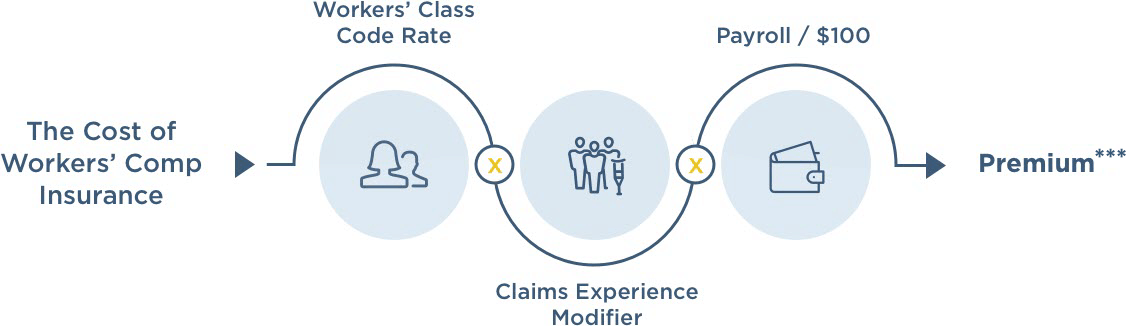
The best way to find out what you’d pay for workers’ compensation insurance is to get a quote online today. You can also use this formula to estimate your workman comp insurance cost:
 
formula for estimating your workers’ comp insurance cost
If you have workman’s comp insurance, your employees are covered. Several factors, like specific roles and the size of your business, can help determine which employees need workers’ compensation coverage. The requirements for workers’ comp coverage will vary by state but most require a workers’ comp policy for full-time employees.
If you’re self-employed or a sole proprietor, your state laws may not require you to carry workers’ compensation insurance for yourself. You may still be able to choose coverage for work-related injuries or illnesses. Requirements and eligibility vary by state and business structure. Learn more about workers’ comp insurance for self-employed and independent contractors.
Workers’ compensation is typically used for employer-to-employee relationships, but it can also apply to independent contractors, too. If you work as a general contractor or a subcontractor, you may have to buy workers’ comp insurance if the contract you signed requires it. If you own a small business that hires contractors, keep in mind that any employee who accepts workers’ comp benefits loses the ability to sue your business for damages.
 
 
Last Updated: September 17, 2026
** Costs, premiums, and coverages mentioned are estimates and are not guaranteed. Actual cost, premium, and coverage are determined at the time of quote or issue and are specific to an individual risk. Premiums are based on information provided to The Hartford, including, but not limited to, underwriting and rating criteria. All examples included on this website or in an advertisement are intended for informational purposes only and are not an offer or a guarantee of premium or coverage. Coverage and products described are subject to the terms and conditions found in the policy contract. Any educational information provided about available coverages does not modify the policy language or imply that any claim is covered. Products are not available in all states or for all businesses.
*** This is a simplified calculation for educational purposes only. Actual premium calculations can be more complex. Experience mods are subject to state requirements and do not apply to every policy.
 
**** Direct deposit is not available in all states.
E “World’s Most Ethical Companies” and “Ethisphere” names and marks are registered trademarks of Ethisphere LLC.
 
Additional disclosures below.
The Hartford shall not be liable for any damages in connection with the use of any information provided on this page. Please consult with your insurance agent/broker or insurance company to determine specific coverage needs as this information is intended to be educational in nature.
 
The information contained on this page should not be construed as specific legal, HR, financial, or insurance advice and is not a guarantee of coverage. In the event of a loss or claim, coverage determinations will be subject to the policy language, and any potential claim payment will be determined following a claim investigation.
 
Certain coverages vary by state and may not be available to all businesses. All Hartford coverages and services described on this page may be offered by one or more of the property and casualty insurance company subsidiaries of The Hartford Insurance Group, Inc. listed in the Legal Notice.
 
The Hartford Insurance Group, Inc., (NYSE: HIG) operates through its subsidiaries under the brand name, The Hartford, and is headquartered in Hartford, CT. For additional details, please read The Hartford’s Legal Notice.
 
* Customer reviews are collected and tabulated by The Hartford and not representative of all customers.